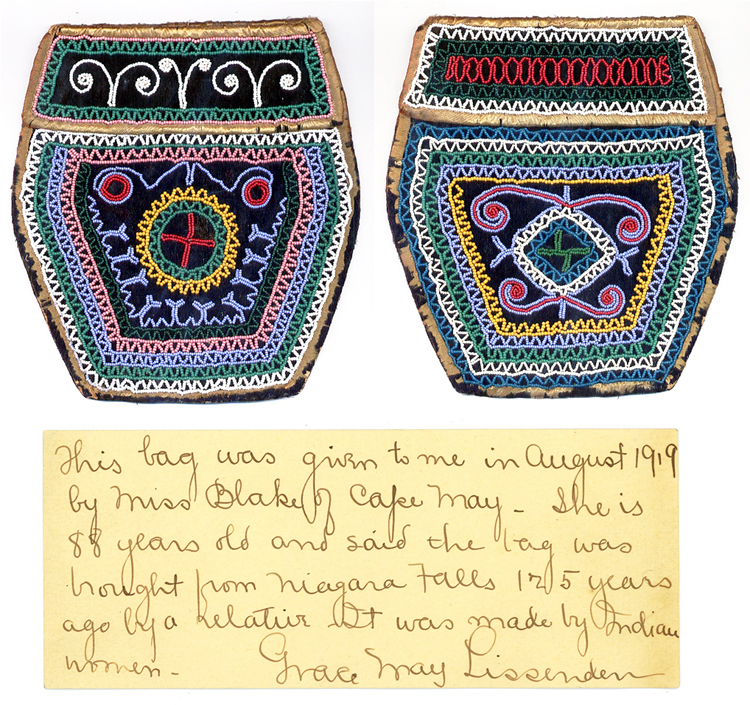
During the nineteenth century, several writers have given us an account of the places where Iroquois artisans took up residence during the travel season to sell their work. There is also a small corpus of images of these encampments and both will be discussed in this posting.
Throughout the Victorian period, women acquired a sentimentalized vision of Indian life from prints and magazine articles in which Native people were often inaccurately depicted as still living in quintessential harmony with nature. Indian encampment life was romanticized by some writers, such as a Mademoiselle Rouche, who wrote an account of one in the 1859 edition of the Lady’s Newspaper, a British publication. The encampment in her apocryphal account was “perhaps located on the picturesque shores of some vast lake, where the giant trees shut out the oppressive beams of the burning sun, where the day-light is softened down by shades of foliage, weaving, like the many folds of Nature’s curtains, as the soft breeze rustles through them, with a carpet of grass, strewn with wild flowers, and a little streamlet gurgling by on its way towards the lake. In such a spot may the lodge of the Indian have been erected… where a dwelling of birch-bark, with a buffalo skin hung in the opening, which served as a door. Here, no doubt, curling up among the trees of the forest, rose the blue smoke from the blazing faggot-fire, over which the savoury mess of the family meal might be simmering, composed of the wild duck, the squirrel, and such fish as the lake afforded, while around the habitation hunting and fishing implements might be hung about in proof that the supply of nature’s wants was as much a pleasure as a necessity to the half-civilized sojourner in those uncultivated glades and forest depths” (as quoted in Phillips 1998:220). The image in figure 1 more accurately represents the harsh reality of Indian encampment life during that period.
 |
Fig. 1- One panel from each of three separate stereo views of a Tuscarora encampment. Location is not specified but likely somewhere near Niagara Falls. The images are all copyrighted 1893 by photographer George Barker of Niagara Falls (private collection). |
These were fashionable vacation hubs for the expanding middle class and many were locales where Indian souvenir items could be purchased.
 |
Fig. 2 – One panel from a stereo view titled “Indian Encampment at Lake George, New York.” Circa 1870. Several ladies in bustle dresses are examining a selection of baskets on the table. Possibly a group of Mohawks. Photographer: R.S. Stoddard, Glen Falls, New York (private collection). |
 |
Fig. 3 – One panel from a stereo view titled “The young Basket Maker, Lake George, New York.” Circa 1870. Possibly a Mohawk from Akwesasne or Kahnawake. Photographer: R.S. Stoddard, Glen Falls, New York (private collection). |
 |
Fig. 4 – One panel from a stereo view titled “Group of Young Indians, Lake George, New York.” Circa 1870. Possibly Mohawks from Akwesasne or Kahnawake. Photographer: R.S. Stoddard, Glen Falls, New York (private collection). |
 |
Fig. 5 – Cabinet card of three young girls standing before the display table of Peter Lawrence, Fancy Basket Maker, at the Lake George Indian Encampment. A large model canoe and a selection of fancy baskets are on display. Dated on the back - August 6, 1892 (private collection). |
 |
Fig. 6 – Images from two separate stereo view titled: Indian Camp, Thousand Islands. From a series titled: Scenery among the Thousand Islands on the River St. Lawrence, from Crossmon House Photographic Studio, Alexandria Bay, Jefferson County, N.Y. - A.C. McIntyre & Co., Artists. Circa 1870 (private collection). |
 |
Fig. 7 – One panel from a stereo view titled: Indian Camp, Thousand Islands. From a series titled: Scenery among the Thousand Islands on the River St. Lawrence, from Crossmon House Photographic Studio, Alexandria Bay, Jefferson County, N.Y. - A.C. McIntyre & Co., Artists. Circa 1870 (private collection). |
 |
Fig. 8 – Images from two separate stereo views of the Indian Encampment in Saratoga Springs, NY. Circa 1870. Click on the image to enlarge it (private collection). |
 |
Fig. 9 – Images from two separate stereo views of the Indian Encampment in Saratoga Springs, NY. Circa 1870. Click on the image to enlarge it (private collection). |
 |
Fig. 10 – An engraving titled Indian Encampment, Sharon Springs [New York]. 4.5 inches in height by 4.5 inches in width. From the June 1856, edition of Harper’s New Monthly Magazine (private collection). |
The largest and most famous of these camps was located in Congress Park (fig. 11). This encampment, also referred to as the Gypsy Camp, was originally founded in 1848 where Broadway and Ballston Avenue meet. A band of Indians arrived each year (probably from Canada) to staff the encampment. They arrived in late spring, and stayed through the end of autumn or whenever the first snow arrived.
 |
Fig. 11 – Late nineteenth century photograph of the Indian Encampment at Saratoga Springs, New York. The large sign leading to the Indian encampment reads “Indian Encampment Studio.” Some of the booths where the Mohawk sold their creations can be seen in the distance, below the sign (private collection). |
The camp was moved to Congress Park in the 1870s, on the corner of Circular Street and Spring Street. It remained there until 1902, when Richard Canfield purchased the property and replaced the camp with the Italian Gardens and Trout Pond of Congress Park” (Rollinson 2005).
Some Mohawk beadworkers lived a semi-nomadic lifestyle in an effort to market their crafts. Ruth Phillips has indicated that Vendor’s permits from one Kahnawake family demonstrate that in the late nineteenth and early twentieth centuries, the MacComber’s travelled as far as Colorado and the state of Washington to sell their beadwork (Phillips 1998:33). In a rare encampment image of a family of Mohawks, they can be seen seated before a display of their beadwork (fig. 12). The beaded whiskbroom holder directly above the woman’s head is dated 1897, in beads. The designs on the man’s coat depict a lion and a unicorn. These are old Scottish and British heraldic representations and as such suggest a British tie-in. In 1860, Albert Edward, the Prince of Wales, visited the Grand River Reserve in Brantford, Ontario. Nine years later, the young Prince Arthur, Duke of Connaught visited there and was made an honorary chief. So there may be a connection between these events and the symbols on the man’s jacket. At the very least the heraldic icons suggest a Canadian origin for this exceptional image.
 |
Fig. 12 – Late-nineteenth century cabinet card of a family of Mohawks in front of a display of their beadwork. 6.5 inches high by 4.25 inches wide. The whiskbroom holder above the woman’s head is dated 1897 in beads. No photographer or location indicated (private collection). |
We advanced cautiously for fear of alarming the poor people, and found two women – an elder and a younger, mother and daughter, seated under a very airy kind of tent, which consisted, indeed, of nothing more than a large cloth spread over a few boughs of trees tied together. The elder woman was occupied in basket-making; the younger was stirring the fire, made of great branches and roots of trees, and both had their naked feet in the hot ashes, so that they seemed to me too be roasting. They remained quite undisturbed and busy at their work, and when we wished them good evening, answered our salutation very simply, without asking us any questions about what we wanted or where we came from.
We expressed a hope that we had not frightened them, and they said, no; they had heard us coming when we were a good way off. We sat down by the fire, and continued the conversation; but their answers were always shorter than our questions. We learned that they were Iroquois, from a village on the ‘Lake of the Two Mountains,’ that I had passed the day before. The men of the family, father and son-in-law, had gone further up the Ottawa to hunt, some months ago; the women had accompanied them as far as Bytown [the former name of Ottawa], and were waiting for them to return afterwards together to their village on the lake, and in the mean time were earning their living by basket-making. They worked in the evening and at night, and in the day-time the daughter carried their little manufactures to the town, and the mother took care of the tent, looked for berries, boiled maize, and got something for the daughter to eat on her return. The old woman spoke no word of English, but the daughter, who also understood a few words of French, made civil replies to our questions.
A hundred yards off there was another “camp,” as it was called, though it consisted, like this, of only a single tent. To this, which was an Algonquin camp, we scrambled over the rocks and other natural barricades that had been left between the two. The occupants were precisely as in the tent of the Iroquois, and old and a young woman, but from certain whimpering sounds that proceeded from under a sheep-skin, we perceived that the younger woman had two children. Here also the elder matron was deaf and dumb to European language, and only the younger could speak a little broken French. While we were talking, the former sat still without granting us so much as a look, thought her fingers continued in busy motion over the large basket that she had in hand; and the elastic strips of wood were pushed hither and thither, and the superfluous ends fell under her knife almost with the rapidity of an American steam saw-mill. We inquired, the daughter being interpreter, whether she would not now allow herself a little rest, as it was now ten o’clock; but she replied very briefly: ‘The baskets bring in very little. They must be ready to-morrow. We work every night.’ When we asked how old she was, the daughter’s French arithmetic quite broke down. She could count as much as ten, but was puzzled how to express any higher number, and therefore explained to her mother in Algonquin what we wanted to know.
As soon as she had understood the question, the old lady laid aside her basket, spread out her ten fingers, and then struck her two hands at regular intervals seven times together; she then snatched her basket again, and went on plaiting as busily as before.
I could not get out of my head the picture of this grey-haired woman of seventy sitting there on the bare damp ground in the comfortless forest, so hard at work: and I could not help thinking that the accusation of sloth, so commonly made against the poor Indians should be received ‘cum grano salis,’ [with a grain of salt]” (Kohl 1861:272-275, vol. 1).
The Mohawk also sold their work on the streets of Montreal (fig. 13). This engraving appeared in the July 13, 1861 edition of Frank Leslie’s Illustrated Newspaper. The article was titled Indian Women of Montreal and the text that accompanied it read as follows:
“Who has not seen in the streets of New York, at Saratoga, at Niagara, and especially at Montreal, those short, round, strangely-dressed, half Chinese looking women, whose appearance puzzles foreigners so much, but whom our world unites in terming Indian squaws? Always clad, in the warmest weather, in one vast blue blanket, covering the whole figure from head to foot, always bearing a basket, always quiet, they illustrate, after two centuries of life in contact with white people, the original state of woman among savages - that of uncomplaining, patient endurance. Come upon them in one of their gipsy like encampments, and you will find them at domestic duty, or patiently working their moccasins and baskets; see them abroad, there is still the same animal-like endurance.
Many of these squaws, especially those who have some French blood in their veins, are very beautiful. We have seen one at Niagara who was both sprightly and graceful, and for several years Nancy, at Sharon, was quite a belle, selling her horsehair ear-rings at preposterous prices to young gentlemen. But, as a rule, the half-breed squaw, or the Indian, is a rather plain, somewhat giving to sulking, and seldom very lively; “Ugh!” and “Two shillin’!” forming the average limits of her English conversation.
Our engraving represents two extremely well know moccasin and pincushion sellers of Montreal, who will at once be recognized by such of our readers as are familiar with that city. Like the florare, or flower-girls of Florence, they are general acquaintances, but seek their special patrons in strangers. Many of their wares are really beautiful, and are regarded as the most characteristic and charming presents which can be sent from the New World to the Old.”
Many of these squaws, especially those who have some French blood in their veins, are very beautiful. We have seen one at Niagara who was both sprightly and graceful, and for several years Nancy, at Sharon, was quite a belle, selling her horsehair ear-rings at preposterous prices to young gentlemen. But, as a rule, the half-breed squaw, or the Indian, is a rather plain, somewhat giving to sulking, and seldom very lively; “Ugh!” and “Two shillin’!” forming the average limits of her English conversation.
Our engraving represents two extremely well know moccasin and pincushion sellers of Montreal, who will at once be recognized by such of our readers as are familiar with that city. Like the florare, or flower-girls of Florence, they are general acquaintances, but seek their special patrons in strangers. Many of their wares are really beautiful, and are regarded as the most characteristic and charming presents which can be sent from the New World to the Old.”
 |
Fig. 13 – 1861 engraving from Frank Leslie’s Illustrated Newspaper. |
 |
Fig. 14 – One panel from each of two separate stereo views of the Indian encampment at the Quebec Tercentenary, July 1908. The individuals in the left image are identified as “Scar-Face and American Horse, chiefs of the Iroquois.” The left image is by Underwood and Underwood. The right image is by the Keystone View Company. |
References Cited
Kohl, John G.
1861 Travels in Canada, and Through the States of New York and Pennsylvania. Translated by Mrs. Percy Sinnett. Revised by the author. In two volumes. Volume 1. London: George Manwaring, publisher.
Phillips, Ruth
1998 Trading Identities: The Souvenir in Native North American Art from the Northeast, 1700 – 1900. University of Washington Press, Seattle and London: McGill-Queen’s University Press, Montreal and Kingston.
Rollinson, Emily
2005 From a paper titled: Indian Encampments, written under the advisement of Dr. William Fox (now retired), Skidmore College. The paper was published online at: https://academics.skidmore.edu/saratoga_census/wiki/index.php/Indian_Encampments